
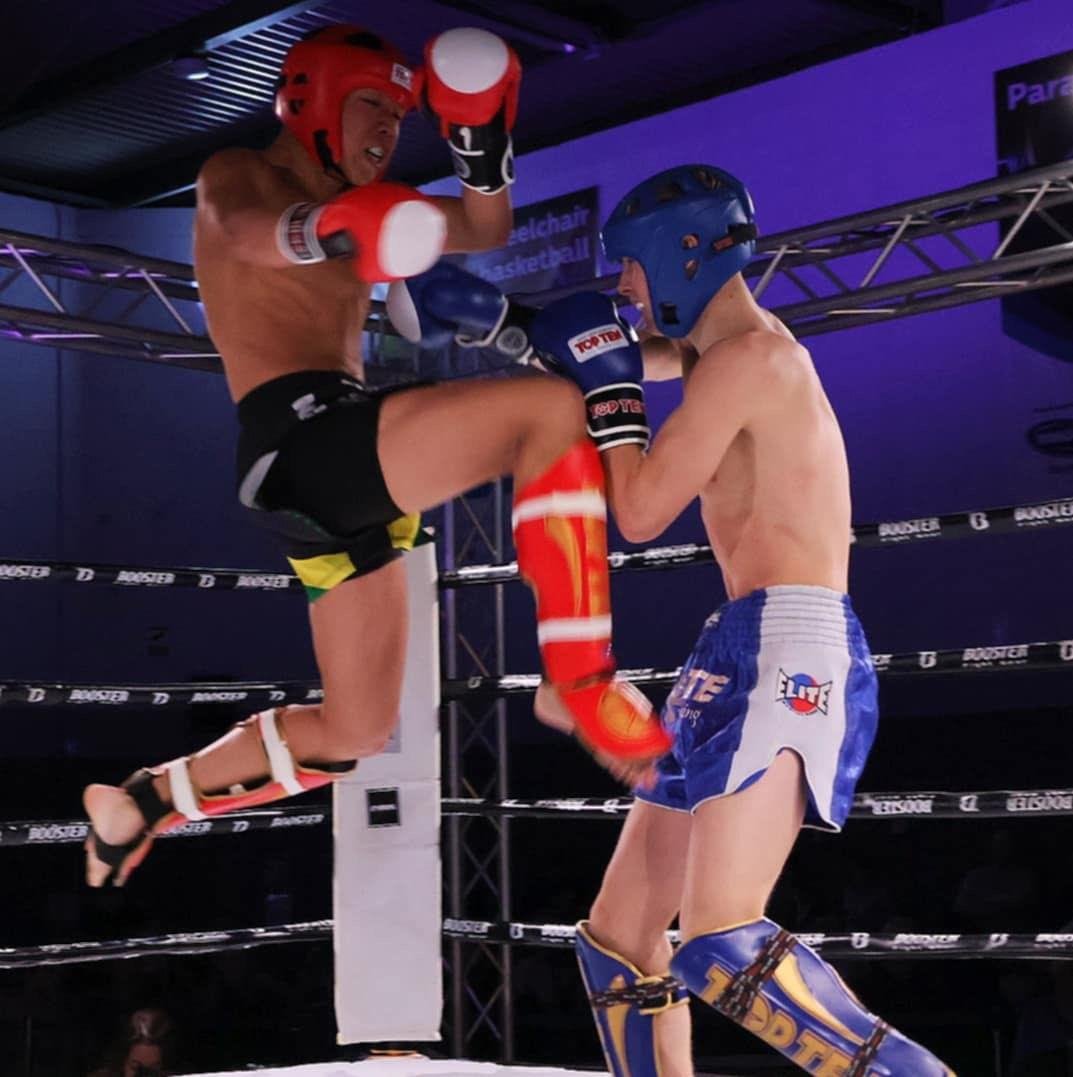
Every fighter has an area of the game where they feel most at home. For Tadgh Watters, that place is on the feet.
With a strong background in striking and competitive experience across both kickboxing and mixed martial arts, Tadgh has been developing a combat-sports journey that has allowed him to test his stand-up skills under very different rulesets.
Moving between the kickboxing ring and MMA cage requires adaptability. The distance changes, the threats change and the approach to striking has to change with them.
For Tadgh, that challenge has become part of his development as a fighter.
Striking is one of the most technical elements of combat sports.
Power certainly matters, but the best strikers understand that there’s far more involved than simply throwing hard punches and kicks.
Timing, distance, movement, combinations, defence and composure all become critical when facing another trained fighter.
Tadgh’s striking background has given him the opportunity to spend time developing those fundamentals before putting them to the test in competition.
And rather than limiting himself to one discipline, he has been willing to compete under both kickboxing and MMA rules.
Kickboxing provides an environment where a fighter’s stand-up ability is placed firmly under the spotlight.
There is nowhere to hide from the striking exchanges.
Competitors need to manage range, deal with combinations and remain composed when their opponent begins applying pressure.
For a developing striker like Tadgh, competing in kickboxing provides valuable experience that can’t be completely replicated through sparring in the gym.
Once the opening bell sounds, technique has to work against an opponent who is equally determined to impose their own game.
That competitive experience can become extremely valuable when transitioning into other combat sports.
Tadgh has also stepped into the world of mixed martial arts, where striking becomes a very different challenge.
Techniques that work perfectly in kickboxing sometimes have to be adjusted when takedowns, wrestling and submissions are introduced.
Footwork changes.
Distance changes.
Even the way a fighter throws combinations can change when an opponent has the option of shooting for a takedown.
For someone coming from a strong striking background, learning how to maintain those weapons while accounting for the additional threats of MMA becomes an important part of development.
Tadgh’s experience competing in both sports gives him the opportunity to understand those differences firsthand.
One of the most interesting aspects of competing across kickboxing and MMA is how differently the same fighter can be forced to perform.
Inside a kickboxing contest, Tadgh can concentrate completely on the stand-up battle.
In MMA, the striking remains a weapon, but it has to work alongside takedown defence, wrestling, grappling and cage control.
That crossover can help create a more adaptable fighter.
Kickboxing provides valuable striking rounds under competitive pressure, while MMA forces a striker to understand how those skills fit into a much broader fight.
Every contest therefore adds another layer of experience.
A strong striking background provides an excellent foundation, but MMA demands that every fighter eventually becomes comfortable outside their strongest area.
That’s where development becomes particularly interesting.
For Tadgh, continuing to improve the wrestling and grappling elements of his game can create even more opportunities to use the striking skills he already possesses.
The better a fighter becomes at controlling where a fight takes place, the more opportunities they have to dictate the type of contest they want.
That process takes time, particularly at amateur level.
But that is exactly what amateur competition is designed for.
Fight records will always attract attention in combat sports, but they don’t tell the complete story of a developing competitor.
Every fight provides information.
A kickboxing contest might expose something that needs improving in a fighter’s defence.
An MMA fight might highlight an area of wrestling or grappling that requires additional attention.
Those lessons then return to the gym.
Training changes, techniques improve and the fighter who appears in the next contest can be considerably different from the one who competed previously.
For Tadgh, competing across multiple disciplines provides even more opportunities to learn those lessons.
With experience already gained in kickboxing and MMA, Tadgh has several possible directions in which he can continue developing.
What remains consistent is the striking foundation at the centre of his game.
Every additional kickboxing contest provides another opportunity to sharpen those skills, while every MMA appearance tests his ability to apply them in an environment where almost anything can happen.
As the experience continues to build, it will be interesting to see how Tadgh’s style evolves and how far he can take his competitive journey.
One thing is certain: whether it’s under the lights in a kickboxing contest or with the cage door closing behind him in MMA, Tadgh Watters is a fighter who wants to test his striking for real.
And that’s exactly why he’s one to keep an eye on.
Belfast based company supplying a range of mixed martial arts apparel and custom fight kits
Enter your email to receive our latest update and offer!
Copyright © 2024 RND1MMA. All rights reserved. By BelfastIT.com